About Our Springs
Florida Aquifers
Florida’s aquifers provide many people in northeast and central Florida with their fresh water. Aquifers are underground cave systems made of porous rock that hold water and allow water to move through the holes in the rock. Most aquifer systems are made up of sand, shell, clay, and limestone rock. Both freshwater and salt water can be found in the aquifer. Freshwater is typically found in the upper layers of the aquifer, while salt water is present at greater depths. This map shows the different aquifer systems in Florida.
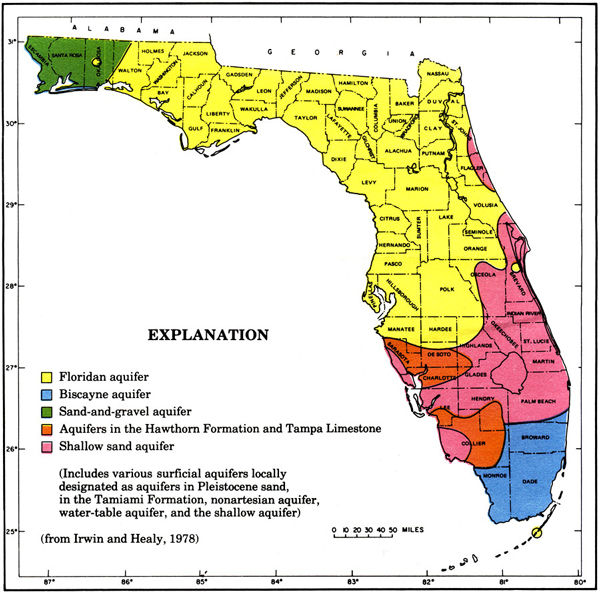
Florida Aquifer map found on: fcit.usf.edu
A Peek at Our Springs
Types of Springs
Florida is home to two types of Springs: Karst (artesian springs) and Seeps (water table springs). Karst springs are the most common and form when groundwater discharges to the surface through a karst opening.
The most common type of Karst Springs in Florida are:
- Sand boils
- Caves
- Rock crevice’s
- Spring vents
Seep springs occur when rainwater infiltrates through permeable sediments encountering a layer of much less permeable deposits. This forces the water to move laterally, resulting in the water reaching the surface of a low-lying area, forming a seep.
During your visit to Crystal Springs Preserve, you will have the opportunity to view sand boils, cave boils, and rock crevices. Each of these karst springs contributes to the 30 million gallons of water that leaves our site daily and flows into the Hillsborough River. The Hillsborough River triples in size as it passes by our spring system!
Magnitude of Springs
Springs come in all different sizes and shapes! Springs are measured based on the amount of water that is being discharged daily and these categories are known as magnitudes. Springs in Florida range in size from a 1st Magnitude to an 8th Magnitude.
1st Magnitude springs discharge on average >65 million gallons of water per day
3rd Magnitude springs discharge between 0.65-6.5 million gallons of water per day
4th – 8th Magnitude springs discharge <.65 million gallons of water per day
Crystal Springs is the largest 2nd magnitude spring system this far south in Florida. On average, 30 million gallons of water flows from Crystal Springs Preserve into the Hillsborough River! We have documented over 100 springs on our site. Of those 100 springs, approximately 44 of them are in our spring fed pool.
Anatomy of a Spring
Florida has over 900 springs! Springs are naturally fed by the Floridan Aquifer. Springs are places where groundwater (in the aquifer) discharges to the surface. When rain falls from the clouds, CO2 is dissolved in the rain drops. The rainwater percolates through the soil, sand, clay, and limestone. Once the rainwater hits the limestone, the CO2 dissolves the limestone creating cracks and holes. Over long periods of time, these cracks widen and eventually allow the water from the aquifer to escape to the surface, forming a spring. These springs provide a window into the aquifer. The map below shows the various springs in Florida.

Florida Spring map retrieved from: floridasprings.org
Biodiversity of a Spring
Florida springs are home to a multitude of reptiles, fish, amphibians, birds, insects, mammals, and plants. Since Florida springs stay at a constant 72 degrees year-round, they can support a variety of plant life including: cypress trees, orchids, lilies, and tape grass. All these plants provide a habitat for some well-known animals in Florida including: the American alligator, manatee, river otter, turtles, and many species of fish.
When viewing our spring-fed pool you will notice the large amount of tape grass submerged at the bottom of the pool. You may also get the opportunity to view one of the many alligators that call Crystal Springs home, in addition to soft shell turtles, large-mouth bass, spotted bass, bluegills, anhingas, banded water snakes, brown water snakes, and an abundance of insects.
Support the Preserve
Help us develop the next generation of environmental stewards.